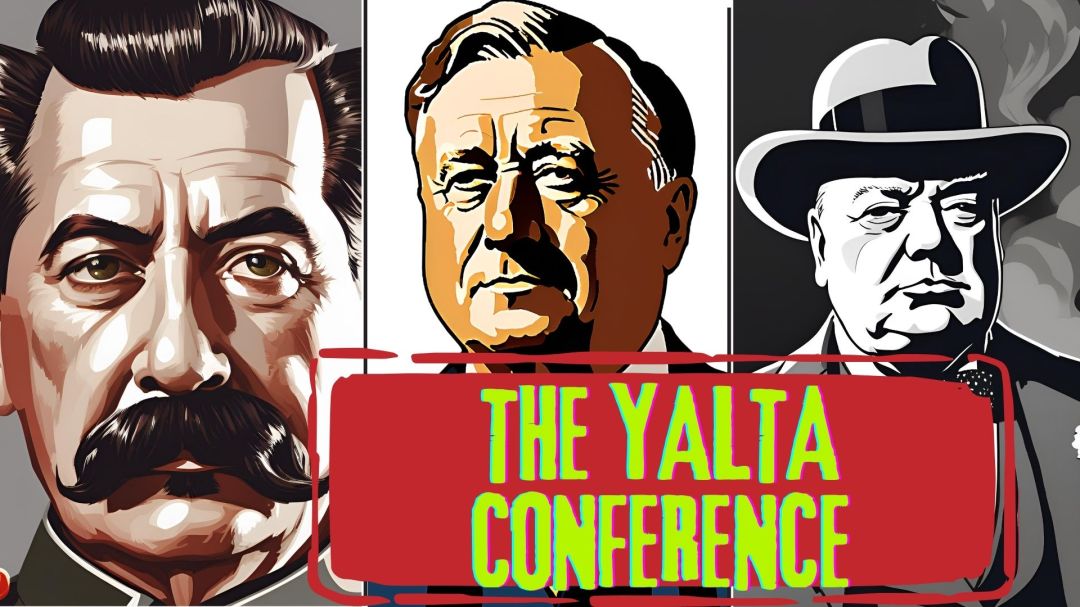
In February 1945, a historic conference took place among the Allied forces fighting against Nazi-fascism. The conference was held in Yalta, Crimea, which at the time was Soviet territory. This was the second meeting of the so-called “Big Three,” namely Franklin Roosevelt, Winston Churchill, and Joseph Stalin, the leaders of the United States, the United Kingdom, and the USSR, respectively. The three had first met together in December 1943 at the Tehran Conference.
The Yalta Conference occurred in early 1945, at a point when the tide of war in Europe had completely turned in favor of the Allied forces, and the circle was tightening around Germany. The goal of the conference was to begin outlining key post-war issues.
At Yalta, discussions focused particularly on the German and Polish situations.
Regarding Germany, it was decided to divide the country into four occupation zones after the war, pending a formal peace treaty to determine its future. These zones would be assigned to the United States, the United Kingdom, the Soviet Union, and France. Additionally, it was agreed that Germany would pay 22 billion in war reparations.
As for Poland, the primary issue was its borders, as the USSR had occupied the country’s eastern regions at the start of the war and was unwilling to relinquish them. This issue was not definitively resolved at Yalta. However, it was decided that post-war Poland would be led by a national unity government to guide the country toward democratic elections.
The same commitment to establish democratic governments through free elections was extended to Bulgaria and Romania.
Finally, other topics were discussed at Yalta, such as the United Nations and the war in Japan.
Concerning the United Nations, which would be established shortly after at the San Francisco Conference, it was decided that a Security Council would be created, with the victorious powers of the war holding permanent seats.
Regarding Japan, which was still fiercely fighting to defend its territorial integrity, Stalin committed to declaring war on the country within three months, providing military support to the Allies. As is well known, the USSR did enter the war, but shortly afterward, the United States dropped two atomic bombs on Japan, forcing the country to surrender immediately.
The Yalta Conference was the last to feature the simultaneous presence of Roosevelt, Churchill, and Stalin—the three major figures in the fight against Hitler and Mussolini. Roosevelt passed away a few months later, while Churchill lost the elections held around the same time as Yalta, resulting in the government being handed over to Labour leader Clement Attlee.
In the years that followed, the Yalta Conference sparked intense historiographical debate. Some argued that Yalta laid the groundwork for the future Cold War by allowing Soviet forces to freely occupy Eastern Europe. However, this interpretation has been contested by the majority of historians, as no division of Europe into spheres of influence was decided at Yalta.
On the contrary, many have pointed out that it was the failure to implement the agreements reached at Yalta—caused by the mutual distrust that developed among the Allies in the post-war period—that created the conditions for the Cold War.

 Pillole di Storia e Filosofia