At the beginning of the 1200s, the Mongol tribes were unified by Temujin, who assumed the title of Genghis Khan (meaning “universal ruler”) and led his people to conquer the Asian continent. His work was continued by his successors, and within a few decades, the Mongols built an empire that stretched from China to Eastern Europe. Under Mongol control, the Silk Road emerged, a major trade route that spanned Asia. Goods from the Far East were transported by caravans to the Mediterranean, and from there, they circulated throughout Europe thanks to European merchants who made substantial profits.
This system entered into crisis in the 15th century with the expansion of the Ottoman Empire. In 1453, Constantinople was conquered, causing a severe disruption in trade.
Europeans began searching for new routes to reach the Indies. Advances in navigation techniques made it easier to embark on long sea voyages, while the rise of humanist culture placed humanity at the center of the world and celebrated the ability to shape one’s destiny. European navigators were thus ready to embark on great geographical explorations.
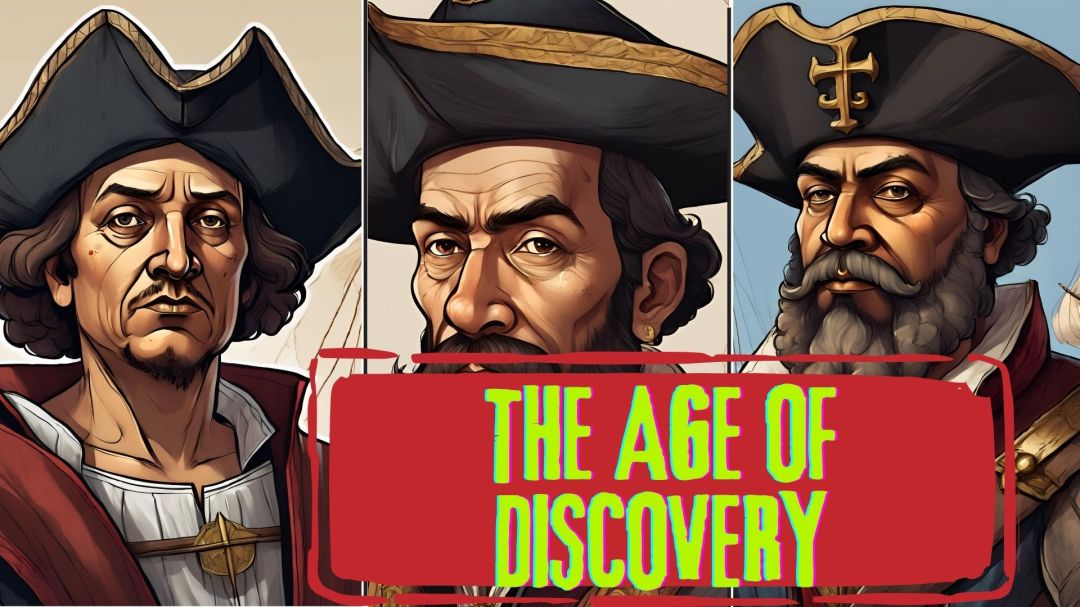
The Portuguese were the first to discover a new route to the Indies. In 1488, Bartolomeu Dias reached the southernmost tip of Africa, discovering the point where the Atlantic and Indian Oceans meet. Ten years later, Vasco da Gama completed the journey and arrived in India.
Meanwhile, the monarchs of Aragon and Castile, Ferdinand and Isabella, financed the voyage of the Genoese navigator Christopher Columbus. Columbus proposed reaching the Far East by circumnavigating the globe westward. On October 12, 1492, Columbus unknowingly arrived on a new continent—America. A few years later, the Florentine Amerigo Vespucci, funded by the Portuguese, realized the magnitude of Columbus’s discovery.
The Portuguese and Spaniards embarked on a fierce conquest of South America. The centuries-old indigenous kingdoms were swept away by the conquistadores, unscrupulous adventurers who arrived in the Americas with a few hundred men and firearms, which were unknown to the indigenous peoples.
The arrival of Europeans was devastating for the Amerindian populations. Conquered through violence and enslaved, the indigenous peoples were decimated by unfamiliar diseases brought from Europe.
Meanwhile, in 1519, the explorer Ferdinand Magellan undertook the most ambitious journey possible: the circumnavigation of the globe. Magellan died during the voyage, but part of his crew returned home in 1522, completing an epic achievement.

 Pillole di Storia e Filosofia